


By Giacomo Carli | The Open University Business School, Associate Head of the Business School – Undergraduate Curriculum
Late June took me to Torino for the CIGR–EurAgEng World Congress 2026 (24 to 26 June), a leading global gathering on engineering and innovation in biosystems. This year’s theme, Emerging Technology and Innovation in Biosystems, sat closely with the work my colleagues and I have been pursuing within the Horizon Europe ICAERUS project. I was glad to contribute both an oral presentation and a poster, each circling the same question: what actually persuades people to adopt drones? Both were developed with Jie Deng (The Open University), and Aikaterini Kasimati and Spyros Fountas (Agricultural University of Athens).
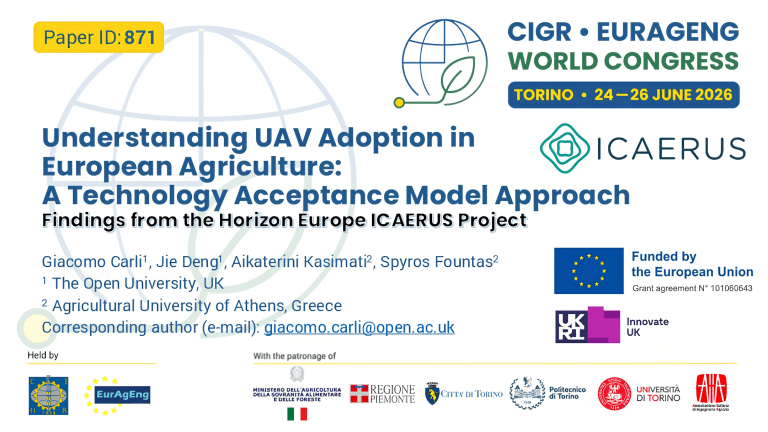
The oral presentation, Understanding UAV Adoption in European Agriculture: A Technology Acceptance Model Approach, applied an extended Technology Acceptance Model (TAM and TAM3) across two contrasting samples: an online survey of 497 respondents across 27 European countries, and in person surveys gathered at five EU demonstration events in France, Greece, Lithuania, North Macedonia, and Spain. The most striking finding was that the decisive driver of adoption shifts with the population. In the large and varied online sample, behavioural intention drew on a whole constellation of factors, from ease of use and competence to confidence and access to resources. Among the more experienced participants at demonstration events, the effect narrowed sharply onto perceived usefulness. Once people genuinely know a technology, the tangible value it offers is what tips the balance.
The poster, Mapping Drone Adoption in Civilian Sectors: A Literature Review of TAM Applications, widened the lens from agriculture to the broader civilian landscape through a systematic Scopus review of 42 empirical TAM based studies. It confirmed that the core acceptance constructs are necessary but rarely sufficient on their own, and that what sets sectors apart is the context specific factors layered on top: economic benefit and trust in agriculture, speed and convenience in last mile delivery, logistics efficiency in healthcare, each with its own barriers around cost, privacy, safety, and regulation.
Taken together, both contributions return to the same insight: adoption is as much about people and context as it is about the technology, and no single formula fits every setting. Reaching broad populations calls for patient capacity building and opportunities to try the technology firsthand, whereas engaging experienced groups depends on demonstrating concrete value. For ICAERUS, and for the wider ambition of building capacity for rural UAV services across Europe, this shapes how we design training, communicate benefits, and direct support to where it is most needed.
I am grateful to my co-authors and to the ICAERUS consortium for the collaboration that made the work possible.
This work was carried out within the ICAERUS project, funded by the European Union under the Horizon Europe scheme (Grant Agreement 101060643) and by Innovate UK (reference 10038181).
