


By Beta Via
12–13 May 2026 · Athens, Greece
Last week, our use case team travelled to Athens for two of the most significant moments in the ICAERUS project calendar — the ICAERUS United Event on 12 May, and the 8th and final Project Management Board (PMB) meeting on 13 May. After nearly four years of fieldwork, flight campaigns, model training and partner collaboration, it was a chance to step back, share results, and align the consortium on the final stretch toward project close.
A united stage for the five use cases
The United Event brought together all of ICAERUS’s partners and use-case teams in one room, with each use case presenting what it set out to do, what it actually delivered, and what it means for the wider drone-and-agriculture community.
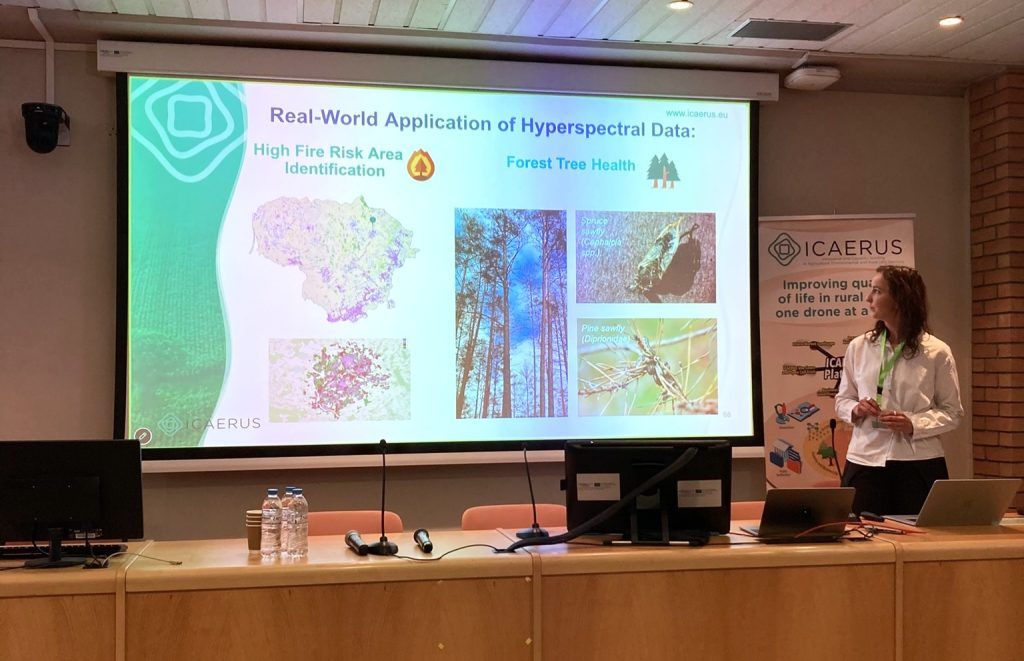
For us at Beta Via, leading the Forestry and Biodiversity Use Case, this was the moment to put our Lithuanian work front and centre. Together with our technical partners at AgriFood Lithuania, we walked the audience through hyperspectral drone flights over Scots pine stands, early detection of spruce sawfly (Cephalcia spp.) and pine sawfly (Diprionidae) damage well before any visible symptoms, fire-risk mapping across whole forest landscapes, and thermal-drone wildlife monitoring of wild boar — a key piece of work given the role wild boar play in the spread of African swine fever.
The numbers behind the demos tell the story: 14 calibrated hyperspectral datasets (533 GB), 8 thermal datasets (203 GB), a tree-health ML model reaching R² = 0.985, and a wildlife detection model achieving 0.98 class accuracy in real thermal-drone conditions — all openly published on Zenodo and GitHub for any forest manager, researcher or developer to use.
The final PMB: closing the loop
The next day, the consortium reconvened for the 8th PMB meeting — the last formal alignment before final reporting. At month 47 of 48, the conversation was no longer about plans, but about closure: validated results across all five use cases, the Drone Data Analytics Library now holding more than 200 contributions, ongoing SEIA assessments, the academy and platform integration, and the sustainability pathway beyond the project’s lifetime.
For Beta Via, the takeaway from both days is the same: the operational value of drone-based forestry and biodiversity monitoring is no longer a hypothesis. It is a demonstrated, documented, and openly shared body of work — and it is ready for the people who will carry it forward.
Huge thanks to the Agricultural University of Athens for hosting, to the entire ICAERUS consortium for four years of collaboration, and to everyone who joined us in Athens to mark this milestone.
